Questions leaders ask before we work together
Straightforward answers about executive coaching, leadership teams, facilitation and the Enneagram.
You may know that something needs to change without yet knowing what kind of support would be most useful. You might be stepping into a bigger role, navigating pressure or complexity, trying to change how a leadership team works, or looking for someone capable of holding an important room.
These are answers to the questions senior leaders, HR professionals, organisational sponsors and leadership teams commonly ask me. They are not intended to persuade you that coaching, facilitation or the Enneagram is always the answer. Sometimes it is. Sometimes something else is needed.
The first task is to understand what is actually happening.
Executive Coaching
What is executive coaching?
Executive coaching is a confidential thinking partnership for leaders operating with responsibility, visibility and complexity.
It creates protected space to examine the decisions in front of you, the system around you, the relationships that matter and the patterns shaping how you lead.
At senior level, the challenge is rarely a lack of knowledge. You probably already know how to set objectives, manage performance, lead meetings and make decisions.
The more valuable questions are often different.
What happens to you when the pressure rises? How are you experienced by the people around you? What are you not seeing? What conversations are you avoiding? What does this role or organisation need from you now?
The objective is not simply insight. It is greater choice about how you think, decide, communicate and lead.
Who is executive coaching for?
I primarily work with senior leaders, directors, executives and people moving into roles with greater responsibility, complexity or organisational visibility.
Coaching can be particularly useful when:
- You have recently stepped into a larger role.
- The way you previously led is no longer enough.
- You are navigating change, uncertainty or organisational politics.
- You need to influence people you cannot simply direct.
- Your confidence has been affected by a setback or difficult transition.
- You want to strengthen your executive presence or communication.
- A relationship or team dynamic is limiting your effectiveness.
- You are succeeding externally but questioning something internally.
- You need somewhere confidential to think beyond the immediate pressure.
You do not need to be failing to benefit from coaching. Often the work begins because a capable leader recognises that the next stage requires something different.
How do I know whether I need an executive coach?
You may benefit from an executive coach if you keep returning to the same problem but cannot see a useful way through it.
Perhaps you understand the situation intellectually, but your behaviour is not changing. Perhaps you are receiving feedback that does not match how you see yourself. Perhaps there is a decision you cannot make, a conversation you keep postponing or a version of leadership you are finding increasingly difficult to sustain.
Coaching may also be useful when nothing is obviously wrong. You may simply sense that there is another level of leadership available to you.
A good initial conversation should help determine whether coaching is appropriate. If I believe you need a consultant, mentor, therapist, mediator or another kind of specialist, I will say so.
The purpose of the first conversation is not to make coaching fit every problem.
What can an executive coach help me with?
Executive coaching can support a wide range of leadership challenges, including:
- Leadership transitions
- Strategic thinking and decision-making
- Executive presence
- Confidence and self-trust
- Influence and stakeholder relationships
- Difficult conversations
- Organisational politics
- Communication and personal impact
- Delegation and accountability
- Leading through change and uncertainty
- Relationships with boards, peers and direct reports
- Sustainable performance
- Purpose, identity and direction
- Understanding patterns under pressure
The subject that brings you to coaching is not always where the most valuable work ultimately happens.
A conversation about confidence may reveal a deeper question about identity. A challenge with delegation may involve trust, control or the story you carry about being valuable. A stakeholder problem may reveal something about conflict, power or how you respond when you are not in control.
We begin with the live situation and remain curious about what sits underneath it.
What is the difference between coaching, mentoring, consulting and therapy?
A coach helps you think more clearly, notice patterns, examine choices and take responsibility for what happens next.
A mentor usually brings experience from a relevant role or field and may offer guidance based on what worked for them.
A consultant is generally engaged to diagnose a problem, provide specialist expertise and recommend a course of action.
Therapy may explore emotional distress, mental health, relationships, history and healing. There can be areas of overlap, but coaching is not a substitute for appropriate therapeutic or clinical support.
My coaching is not based on endlessly asking questions while carefully avoiding having a point of view. I may offer an observation, challenge an assumption, share a hypothesis or introduce a useful framework.
I will not tell you how to become a copy of me. The work remains focused on helping you lead with greater awareness and choice.
Do you need experience in my industry to coach me?
Industry experience can be useful, but it is not always the most important factor in choosing an executive coach.
The more important question is whether the coach understands leadership at your level, can work with organisational complexity and is capable of challenging you without oversimplifying your context.
I have worked with leaders and organisations across financial services, energy, transport, technology, media, education, healthcare, construction, consumer brands, professional services and the public and charitable sectors.
That breadth helps me recognise patterns while remaining curious about the particular system in which you work.
I will not pretend to understand your organisation better than you do. My role is to help you see it, and your place within it, from perspectives that may not be available while you are inside the situation.
Where specialist technical or sector knowledge is essential, we will discuss that honestly.
What happens in an executive-coaching session?
There is no standard script.
We usually begin with what is most present or important for you. That may be an immediate decision, an upcoming conversation, feedback you have received, a relationship, a recurring pattern or something you have been reluctant to say aloud.
I will listen, question, reflect, notice and challenge. We may examine the organisational system, the stories you are carrying, how other people could be experiencing you and what may be happening beneath the surface.
At times we may use the Enneagram, narrative approaches, systems thinking, Physical Intelligence or another appropriate lens. The method serves the conversation rather than dictating it.
You may leave with a decision, an experiment, a different question, a conversation to have or something to observe before we meet again.
The work should produce insight, but it must also return to the reality of how you lead.
How long does executive coaching take?
The length of an engagement depends on what you are working on and whether the coaching is self-funded or sponsored by an organisation.
A defined engagement might involve six sessions across approximately six months. Other work may be shorter, more intensive or continue for longer where that remains useful.
Spacing sessions allows time to apply the work in real situations. Leadership does not change only because something became clear during a coaching conversation. It changes through what you notice, practise and choose between sessions.
We will agree an initial structure, objectives and review point before beginning.
Coaching should not continue indefinitely simply because another session can be scheduled. Periodically, we ask whether the work is still serving its purpose and what is now needed.
Is executive coaching confidential?
Yes. Confidentiality is fundamental to effective coaching.
What you discuss in a coaching session remains private, subject to the ethical, legal and safeguarding limits agreed when we contract.
If you are paying for coaching yourself, information is not shared with your employer or another party without your permission.
If an organisation is sponsoring the work, we agree in advance what may be shared. This might include the broad coaching objectives, confirmation that sessions have taken place or a high-level review of progress.
The content of private coaching conversations is not ordinarily reported to the organisation.
This boundary matters. The organisation needs confidence that its investment has purpose, while the leader needs enough trust to think honestly and discuss what is actually happening.
How do I choose the right executive coach?
Credentials and experience matter, but relationship matters too.
Look for someone who:
- Has credible professional training and ethical accountability.
- Understands the level and complexity at which you operate.
- Can offer support without becoming overly reassuring.
- Can challenge you without needing to demonstrate superiority.
- Is willing to discuss confidentiality and boundaries clearly.
- Can explain how they work without forcing every client through one model.
- Has enough self-awareness not to make your coaching about them.
- Feels like someone with whom you could have an honest conversation.
Use the initial conversation to notice how you think in the coach's presence.
Do you feel listened to? Do their questions create movement? Are they willing to say when they may not be the right person?
Chemistry does not mean choosing the person who feels easiest. It means choosing somebody with whom useful, honest work appears possible.
Organisations & Coaching Sponsors
How does organisation-sponsored coaching begin?
We begin by understanding the organisational context, why coaching is being considered and what useful change would look like.
Where appropriate, this may include a conversation involving the leader, their sponsor or line manager and the coach. Together we clarify:
- The purpose of the engagement
- The broad objectives
- Roles and responsibilities
- Confidentiality
- How progress will be reviewed
- What information may or may not be shared
- Practical arrangements
The individual receiving coaching needs to retain ownership of their development. The organisation is making an investment, but the coach should not become a covert reporting channel.
A clear agreement at the beginning prevents confusion later and creates the conditions for both trust and accountability.
How do you balance confidentiality with organisational objectives?
When an organisation sponsors coaching, the objectives may be shared; the content of the coaching conversations remains confidential.
At the beginning of the engagement, I contract with the leader and organisational sponsor about intended outcomes, how progress will be reviewed and what information may be discussed.
A review conversation might explore progress against agreed objectives, what the leader is applying and what organisational support may be needed. It does not require the coach to disclose the private detail of individual sessions.
There are limited exceptions involving legal duties, safeguarding or a serious risk of harm. These are explained when we contract.
The objective is neither secrecy nor surveillance. It is a professional boundary that allows the leader to think honestly while maintaining a meaningful relationship with the organisation funding the work.
How do you establish objectives and measure progress?
We begin by identifying what needs to become different in practice.
“Greater confidence” may matter, but we make it more observable. What would confidence allow the leader to do? Speak with greater authority? Challenge a senior stakeholder? Make decisions sooner? Delegate more effectively? Remain composed under pressure?
Depending on the engagement, progress may be explored through:
- The leader's own observations
- Agreed behavioural objectives
- Feedback from relevant stakeholders
- A sponsor or line-manager review
- Changes in relationships or communication
- Decisions made or conversations completed
- Greater consistency under pressure
- Evidence of changed leadership habits
Not every valuable outcome can be reduced to a number, but the coaching should connect to the leader's real work.
Before beginning, we agree what evidence would tell us that the engagement has been worthwhile.
Can you coach several leaders in the same organisation?
Yes.
I can coach several leaders within one organisation, provided that confidentiality, boundaries and potential conflicts of interest are considered carefully.
Each coaching relationship remains separate. I do not share one leader's session content with another, nor use confidential information gained in one relationship to influence another.
There may also be opportunities to connect individual coaching with wider leadership development, team facilitation or organisational themes. Where that is useful, it must be done transparently and without compromising individual trust.
For larger requirements, I can also work with other trusted coaches and through Zenith Leadership. This allows an organisation to create a coherent coaching offer while still giving individual leaders an appropriate degree of choice and personal fit.
Can executive coaching form part of a wider leadership programme?
Yes. Individual coaching often becomes more powerful when it is connected thoughtfully to the leader's wider development.
Coaching can support participants before, during or after a leadership programme. It can help them:
- Interpret feedback
- Apply programme learning to their role
- Prepare for a live leadership challenge
- Understand personal resistance
- Translate insight into behaviour
- Sustain changes after the formal programme ends
I also design and facilitate leadership workshops, masterclasses and development journeys. This means the coaching and group experience can be connected rather than operating as unrelated interventions.
The boundaries still need to be clear. A participant should understand when I am acting as their confidential coach, when I am facilitating the group and what information remains private.
How is an engagement scoped and priced?
The investment depends on what is required.
For individual coaching, relevant considerations include the number and length of sessions, the duration of the engagement, whether there are sponsor conversations and whether assessments or stakeholder feedback are included.
For teams and organisations, the scope may include diagnosis, interviews, design, assessments, individual debriefs, facilitation, travel and follow-up support.
I do not recommend a large intervention before understanding the situation.
After an initial conversation, I will propose an appropriate structure and clear fee. Where useful, I may offer more than one option, for example, a focused starting point and a more comprehensive engagement.
The aim is to create enough support to make a meaningful difference, not to make the piece of work unnecessarily large.
Can we have an initial conversation before committing?
Yes.
An initial conversation is an opportunity to understand what is happening, what you want to be different and whether I am the right person to help.
For an individual leader, it is also a chemistry conversation. You should have an opportunity to experience how it feels to think with me before committing to a coaching relationship.
For an organisational enquiry, we may explore the context, intended participants, existing support, time frame, internal stakeholders and what has already been attempted.
There is no need to arrive with a perfect brief.
Often the first useful piece of work is clarifying whether the situation requires executive coaching, team development, facilitation, a workshop, or something else entirely.
Leadership Teams & Facilitation
How do I know whether my leadership team needs external facilitation?
External facilitation can help when the team cannot easily lead and observe itself at the same time.
You may notice that:
- Important conversations keep being postponed.
- Meetings produce discussion but little movement.
- The same voices dominate.
- People agree in the room and resist outside it.
- Conflict has become personal, or has disappeared underground.
- The team operates as a collection of functions rather than a collective.
- Strategic decisions are repeatedly reopened.
- A new team has formed without establishing how it will work.
- Change has exposed tensions that were previously manageable.
- The team leader needs to participate rather than facilitate everyone else.
A facilitator does not remove the team's responsibility. My role is to create and hold the conditions in which the team can do better thinking, say what matters and make more deliberate choices together.
What is the difference between facilitation, training and team coaching?
Training usually begins with knowledge or capability that participants are there to learn.
Facilitation helps a group think, work and make progress together. The facilitator pays attention not only to content, but also to participation, energy, silence, power, pace and what is happening between people.
Team coaching focuses on the team as a living system over time. It explores how the team performs its collective purpose, relates to stakeholders, responds under pressure and learns from its own patterns.
In practice, a leadership intervention may contain elements of all three. There may be concepts to introduce, conversations to facilitate and recurring team patterns to coach.
The important question is not what label sounds most impressive. It is what the team needs to be able to do differently because of the work.
Can you work with a leadership team experiencing conflict or low trust?
Yes, although the starting point matters.
Conflict is not automatically evidence of a failing team. Some disagreement is necessary for good decisions. The difficulty arises when conflict becomes personal, unsafe, repetitive or impossible to discuss, or when apparent harmony prevents anything honest from being said.
Before bringing a team together, I will usually speak with the sponsor and may recommend confidential conversations with team members. This helps me understand how the situation is experienced from different positions.
I will not promise that a workshop can repair every relationship.
Where there are serious grievances, active investigations, safeguarding concerns or issues requiring mediation, HR or legal expertise, those needs must be recognised.
Where facilitated team development is appropriate, we create enough structure and safety for honesty without pretending that safety means comfort or agreement.
What happens before a leadership-team session?
The quality of the room is shaped before anybody enters it.
We begin with the purpose. Why this team? Why now? What needs to be possible after the session that is not possible today?
Preparation may include:
- Conversations with the team leader or sponsor
- Interviews with individual team members
- Reviewing relevant strategy, feedback or employee data
- Clarifying the decisions or conversations required
- Designing the session around the team's context
- Agreeing boundaries and expectations
- Considering whether assessment work would be useful
- Planning how learning will be carried into ordinary work
I do not arrive with a generic workshop and look for somewhere to insert it.
The design should respond to the team, the organisation, the work it must perform and what is currently getting in the way.
What happens if something difficult emerges in the room?
Something difficult often needs to emerge for the work to become useful.
My role is to notice what is happening, slow the room down where necessary and help the team engage with the issue without allowing the conversation to become careless or destructive.
That may mean naming a pattern, inviting a voice that has not been heard, distinguishing observation from accusation, testing an assumption or helping the group stay with a question it would normally escape.
I cannot guarantee comfort, agreement or instant resolution.
I can create structure, pay attention to power and participation, and help the team work with what becomes visible.
If an issue requires a different intervention, such as mediation, investigation, therapeutic support or a formal organisational process, I will not pretend that facilitation alone is sufficient.
Is a single workshop enough?
Sometimes. Not always.
A focused workshop can be valuable when the purpose is clear: establishing a team, addressing a defined issue, creating working agreements, introducing a framework or making a particular decision.
A single event is less likely to transform deeply established patterns without follow-through.
Longer team-development work may include:
- Diagnostic conversations
- Individual interviews or assessments
- An initial team session
- Practical agreements and experiments
- Individual or group coaching
- Follow-up sessions
- Review of what has changed
- Support for the team leader
I will recommend a proportionate intervention.
The question is not whether a longer programme is inherently better. It is whether the chosen format gives the team enough opportunity to apply, review and sustain what it discovers.
Can you facilitate senior, international or hybrid groups?
Yes.
I have worked with leaders, teams and organisations across different sectors, levels and contexts, from intimate executive-team conversations to larger leadership programmes and masterclasses.
International and hybrid groups require deliberate design. Language, culture, hierarchy, time zones, technology and differing expectations about participation can all influence what happens.
A hybrid session should not simply reproduce an in-person workshop through a camera. Participation, breakout structures, visual material, pace and decision-making all need to be designed for the format.
For particularly complex or larger assignments, I may recommend co-facilitation.
The aim is for every participant to be part of the room rather than for remote participants to become observers of an event happening somewhere else.
The Enneagram for Leaders & Teams
What is the Enneagram?
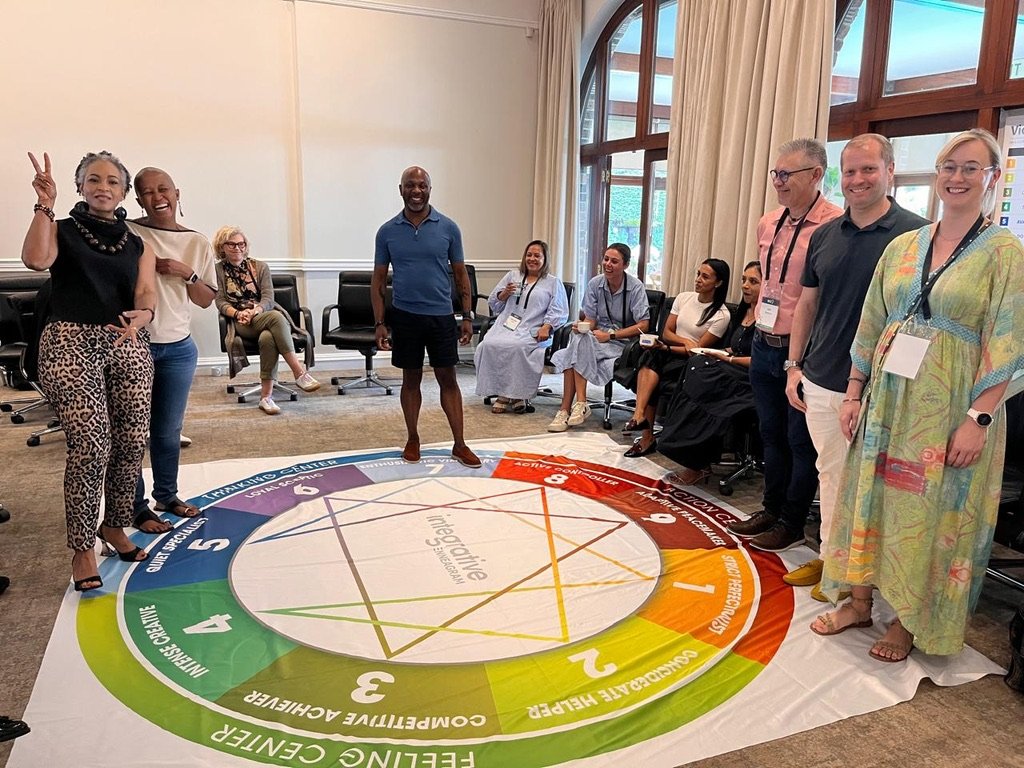
The Enneagram is a framework for understanding recurring patterns of attention, motivation and behaviour.
Many personality tools describe what you tend to do. The Enneagram also invites us to explore why certain responses feel so compelling, particularly when we are under pressure.
It describes nine broad patterns, but the work is more nuanced than assigning somebody a number. It can illuminate:
- What you instinctively pay attention to
- What you may overlook
- How you seek safety, value or control
- How strengths can become overused
- How you respond to stress
- How your intentions may differ from your impact
- Where greater flexibility and choice may be available
I use the Enneagram as a developmental framework, not as a verdict about who somebody is.
The purpose is not to create a better label. It is to create more choice.
What is an iEQ9 assessment?
The iEQ9 is a professional Enneagram assessment designed to support individual, leadership and team development.
You complete the assessment online and receive a detailed report exploring your likely Enneagram pattern and related themes.
The report may include information about motivation, behavioural patterns, strengths, potential blind spots, stress, communication, decision-making, leadership and development.
The assessment is not the destination. It is the beginning of a conversation.
Your report is explored in a professional debrief rather than simply emailed to you without support. Together we consider what resonates, what requires further exploration and how the insights connect with your real life and leadership.
The value comes from applying the material with curiosity. It should help you notice patterns and practise different choices, not encourage you to explain everything with a type number.
How is the Enneagram different from other personality tools?
Different personality tools answer different questions.
Some focus primarily on preferences or observable behaviour. The Enneagram pays particular attention to underlying motivation: what a person may be seeking, protecting or avoiding beneath the behaviour.
Two leaders may behave similarly for very different reasons. Two people with the same broad Enneagram pattern may look very different because of their experience, context, culture, role and level of self-awareness.
The Enneagram is dynamic. It considers how patterns may change under pressure, when we feel secure and as we develop.
I do not use it because every other framework is wrong. Organisations may already use tools that are valuable and familiar.
The relevant question is whether the Enneagram can add a deeper and useful layer of understanding to the challenge being addressed.
Does the Enneagram put people into boxes?
Used badly, any personality framework can become a box.
Used well, the Enneagram helps people see the box they may already be living inside, and discover that they have more choice.
The purpose is not to reduce somebody to a number or use type as an excuse: “I behave like this because I'm an Eight.” “She avoids conflict because she's a Nine.” “He needs everything perfect because he's a One.”
Those statements close curiosity rather than opening it.
Instead, we explore tendencies, motivations and impact. Where does a strength become overused? What happens under pressure? What might another person experience that you do not intend? What becomes possible when your habitual response is not the only response available?
The Enneagram should increase compassion and responsibility, not stereotyping.
What if I do not agree with my assessment result?
That is useful information.
An assessment is not an authority on your identity. It offers a hypothesis to explore.
We look at what resonates, what does not, what may have influenced the result and whether another pattern makes better sense of your underlying motivation.
Behaviour alone can be misleading. People may learn similar behaviours for very different reasons, and professional roles can reward responses that are not necessarily our deepest habits.
The debrief is therefore essential. We explore your experience rather than forcing you to accept a report because a scoring system produced it.
The objective is not to arrive at the “correct number” as quickly as possible. It is to develop a more accurate and compassionate understanding of the patterns shaping your choices.
How can the Enneagram help a leadership team?
A team is more than the sum of its individual profiles.
It develops collective habits around attention, pace, conflict, risk, relationships, decision-making and what can or cannot be said.
Enneagram team work can help make these patterns discussable. A team may begin to see:
- Which perspectives are naturally well represented
- What the group routinely overlooks
- How members communicate differently
- Why certain people experience one another as difficult
- What happens collectively under pressure
- Where particular voices dominate or disappear
- How strengths may also create blind spots
- Which working agreements would improve collaboration
The purpose is not nine people wearing personality labels.
It is a team with a richer language for understanding itself and more choice about how it works together.
Can the Enneagram resolve team conflict?
The Enneagram can help a team understand some of the motivations and patterns underneath conflict, but it is not a magic resolution tool.
It may reveal why colleagues respond differently to urgency, uncertainty, challenge, control, detail, harmony or risk. It can help people distinguish intention from impact and understand why a familiar interaction keeps repeating.
That understanding can make a more constructive conversation possible.
However, insight does not remove accountability. Type should never be used to excuse harmful behaviour, dismiss another person's experience or avoid an organisational issue.
Some conflicts require mediation, formal HR processes, role clarification, structural change or a decision from leadership.
The Enneagram is most useful when it helps the team see more clearly and then make practical changes to how it communicates, decides and works.
What does an Enneagram team engagement involve?
The precise structure depends on the team and its purpose. An engagement may include:
- A scoping conversation — We clarify what is happening, why the work matters and what useful progress would look like.
- Individual iEQ9 assessments — Team members complete the professional assessment privately.
- Individual debriefs — Each participant explores their report, tests the findings and identifies relevant development themes.
- Team preparation — I review the collective material and design the session around the team's real context.
- Facilitated team work — The group explores communication, relationships, strengths, pressure responses and collective blind spots.
- Application — The team creates practical agreements, experiments or commitments.
- Follow-through — Further team sessions or individual coaching may support application where appropriate.
The report is not the outcome. What the team does differently is what matters.
Working with Robert
What is distinctive about Robert Stephenson's approach?
My work combines executive coaching, master facilitation, Enneagram practice, narrative thinking, systems awareness and more than two decades of working with people and groups.
I originally trained in acting and physical theatre before moving into education, training, coaching and organisational development.
That background still matters. I understand something about rooms: energy, attention, story, silence, participation, safety, challenge and timing.
I am interested in both the organisational challenge and the human being experiencing it.
Clients can expect warmth, curiosity, challenge, careful attention and questions they may not have anticipated. I may notice what is not being said, test the story surrounding a problem or invite you to examine how you are participating in the situation.
I take the work seriously without believing that every useful conversation needs to feel unnecessarily serious.
What experience does Robert have?
I have spent more than two decades coaching, training and facilitating. My professional journey has included senior roles within Animas Centre for Coaching, including Centre Director, alongside work as a senior coach, facilitator and associate with organisations including Ivy House London, More Happi, Jenny Bird Executive Coaching, Elev-8 Performance and the Physical Intelligence Institute.
I am Managing Partner of Zenith Leadership and an ICF Professional Certified Coach.
My direct client work includes Cormack Advertising, More Happi, Elev-8 Performance, Estée Lauder, Skyscanner and the Open University Students' Union.
I have also delivered programmes as an associate connected to RS Group, BT, the NHS, Ford Motor Company, Cala Group, the Premier League Charitable Fund, a FTSE 100 energy company and a global music label.
Some work is delivered directly, and some through associate relationships or wider leadership programmes.
What qualifications and professional approaches does Robert bring?
I am an International Coaching Federation Professional Certified Coach and an accredited Enneagram practitioner using the iEQ9 professional assessment.
My work also draws on training and experience in:
- Transformational coaching
- Narrative coaching
- Coach supervision
- Systems thinking
- Physical Intelligence
- NLP
- Hypnotherapy
- Facilitation and experiential learning
- Performance, acting and physical theatre
Qualifications matter. They provide professional foundations, ethical accountability and evidence of sustained practice.
They are not the whole relationship.
The other questions are whether a coach can listen beyond the obvious, understand complexity, hold an honest conversation and help insight become useful in the world outside the coaching session.
Does Robert work independently and through Zenith Leadership?
Yes.
I work directly with individual leaders, leadership teams and organisations through my own practice.
I am also Managing Partner of Zenith Leadership, where I work alongside Will Harvey and other trusted professionals to provide executive coaching, leadership development, team work and organisational programmes.
The most appropriate route depends on the scale and nature of the requirement.
An individual coaching relationship or focused piece of facilitation may be delivered directly. A broader organisational programme, multiple-coach requirement or engagement combining different areas of expertise may be better supported through Zenith.
You do not need to determine this before getting in touch. We can discuss the situation and recommend the most appropriate arrangement.
Do you work online and in person?
Yes.
Executive coaching can take place online or in person, depending on location, preference and the nature of the engagement.
Online coaching can be highly effective and allows us to work consistently across locations and demanding schedules.
Leadership-team facilitation, workshops and Enneagram team sessions may be delivered in person, online or in a carefully designed hybrid format.
The format should serve the work.
Some conversations benefit from the flexibility and focus of meeting online. Some team situations benefit from sharing a physical room. Hybrid work requires particular care so that remote participants are not relegated to watching an event happening elsewhere.
We will agree the format that best supports the people, purpose and practical context.
How do I start a conversation?
You do not need to arrive with a polished brief or know whether you need coaching, facilitation, team development or Enneagram work.
Tell me what is happening.
What has changed? What feels difficult? What have you already tried? What would you like to be different?
Our first conversation is an opportunity to understand the situation, consider what kind of support might be useful and establish whether there is a good fit.
There is no performance required and no expectation that you commit before we have spoken.
Still deciding what kind of support you need?
Executive coaching
A confidential thinking partnership for senior leaders navigating responsibility, visibility, transition and complexity.
Explore Executive Coaching →Leadership teams and facilitation
Bespoke work for leadership teams that need to think, decide, communicate or work differently together.
Explore Leadership Facilitation →Enneagram for leaders and teams
Professional iEQ9 assessment and facilitated development focused on motivation, communication, pressure and collective patterns.
Explore Enneagram Work →Leadership gets more complex the higher you go.
You do not need to have the answer before beginning the conversation. You only need somewhere useful to begin.