Leadership Facilitation & Workshops
Sometimes the work isn't with one person. It's with the room.
This is where twenty years of coaching meets a lifetime fascination with performance, communication and human behaviour. I originally trained in acting and physical theatre before moving into education, training, coaching and organisational development. That background still matters.
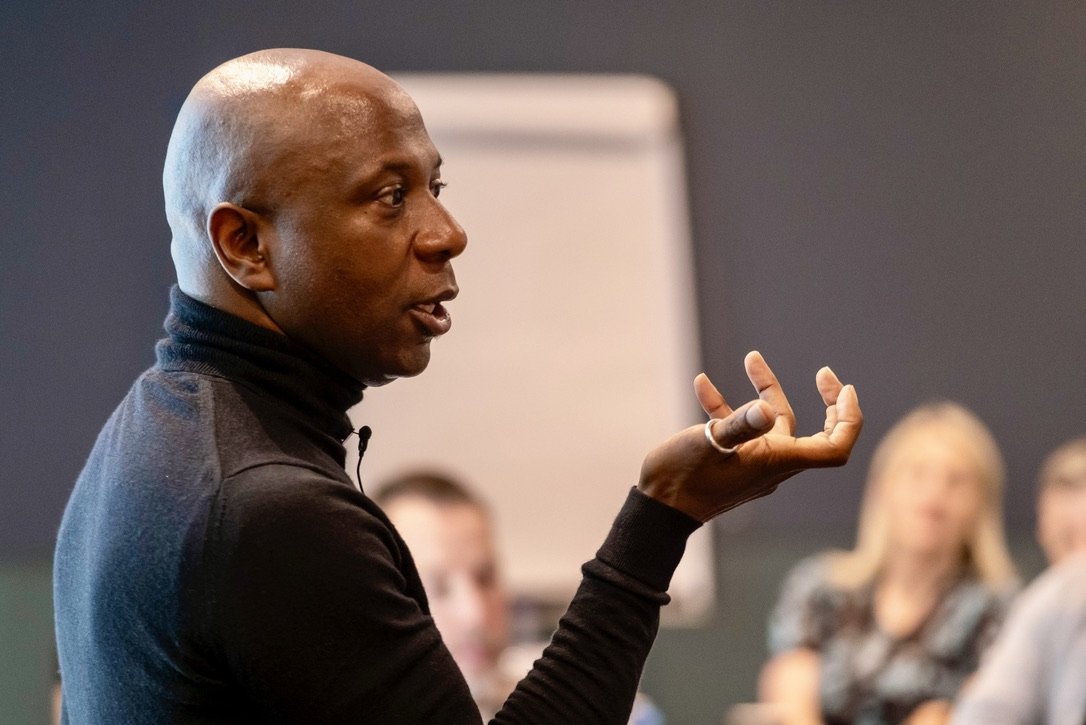
I understand something about rooms. Energy. Attention. Story. Silence. Participation. Safety. Challenge. Timing. And the moment when a group stops attending a workshop and starts having a conversation that actually matters.
I design and facilitate leadership experiences ranging from intimate executive team sessions to large leadership programmes and masterclasses. My job isn't to stand at the front and deliver content at people. It is to create the conditions in which people think, participate, challenge themselves, experiment and leave seeing something differently.
Programmes can be standalone interventions or form part of a wider leadership development journey.
When external facilitation helps
External facilitation can help when the team cannot easily lead and observe itself at the same time.
You may notice that:
- Important conversations keep being postponed.
- Meetings produce discussion but little movement.
- The same voices dominate.
- People agree in the room and resist outside it.
- Conflict has become personal, or has disappeared underground.
- The team operates as a collection of functions rather than a collective.
- Strategic decisions are repeatedly reopened.
- A new team has formed without establishing how it will work.
- Change has exposed tensions that were previously manageable.
- The team leader needs to participate rather than facilitate everyone else.
A facilitator does not remove the team's responsibility. My role is to create and hold the conditions in which the team can do better thinking, say what matters and make more deliberate choices together.
What happens before a session
The quality of the room is shaped before anybody enters it.
We begin with the purpose. Why this team? Why now? What needs to be possible after the session that is not possible today?
Preparation may include:
- Conversations with the team leader or sponsor
- Interviews with individual team members
- Reviewing relevant strategy, feedback or employee data
- Clarifying the decisions or conversations required
- Designing the session around the team's context
- Agreeing boundaries and expectations
- Considering whether assessment work would be useful
- Planning how learning will be carried into ordinary work
I do not arrive with a generic workshop and look for somewhere to insert it.
The design should respond to the team, the organisation, the work it must perform and what is currently getting in the way.
Common questions about facilitation
Can you work with a leadership team experiencing conflict or low trust?
Yes, although the starting point matters. Conflict is not automatically evidence of a failing team, the difficulty arises when it becomes personal, unsafe, repetitive or impossible to discuss.
Where there are serious grievances, active investigations or safeguarding concerns, those needs must be recognised. I will not promise that a workshop can repair every relationship.
Is a single workshop enough?
Sometimes. A focused workshop can be valuable when the purpose is clear: establishing a team, addressing a defined issue, creating working agreements or making a particular decision.
A single event is less likely to transform deeply established patterns without follow-through. I will recommend a proportionate intervention rather than a bigger one than the situation needs.
Can you facilitate senior, international or hybrid groups?
Yes. International and hybrid groups require deliberate design, language, culture, hierarchy, time zones and differing expectations about participation can all influence what happens.
A hybrid session should not simply reproduce an in-person workshop through a camera. For particularly complex assignments, I may recommend co-facilitation.
Leadership gets more complex the higher you go.
You do not need to have the answer before beginning the conversation. You only need somewhere useful to begin.